[Column] What Impact Will Trump's Tariffs Have on Japanese Anime?
At the end of July, the U.S. and Japan reached an agreement on tariff negotiations, and starting August 1, imports from Japan to the U.S. are expected to face a 15% tariff.
The main focus is on automobiles, semiconductors, and agricultural products, but anime have now become representative exports of Japan.
In this column, I would like to examine how the Trump tariffs could affect Japan's content industry and American anime fans.

Anime Japan 2025
Minor Impact on Anime Itself? Digital Distribution Remains Tariff-Free
As of 2023, Japan's anime industry has reached the following scale:
Total Market Size: 3.2014 trillion yen (approx. $21.63 billion)
Overseas Revenue: 1.6963 trillion yen (approx. $11.47 billion) – 53.0% of the total
Domestic Revenue: 1.5051 trillion yen (approx. $10.17 billion) – 47.0% of the total
What is noteworthy is that in 2023, the overseas market surpassed the domestic market for the first time in history. This marks a turning point for Japan's anime industry.
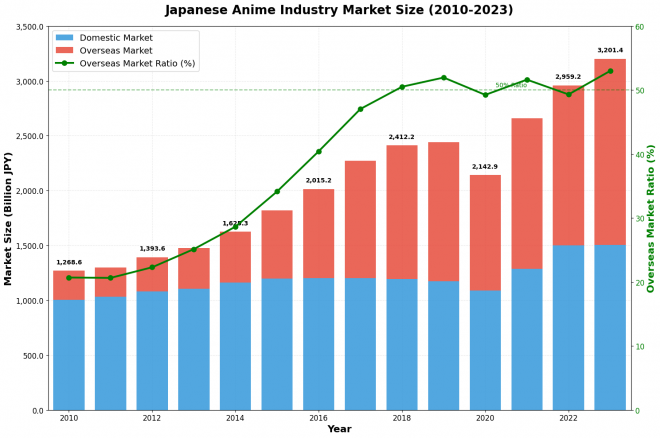
Transition of Total Anime Industry Market Size (Created by the Author)
From August 1, the new tariff rules are expected to be as follows:
Items currently under 15% tariff: raised to 15% flat rate
Items already above 15% tariff: existing rates remain
Digital content: 0% (exempt)
The good news for anime fans is that, under WTO regulations, digital distribution will remain untaxed, meaning streaming platforms will be unaffected.
Fans can continue enjoying anime on services like Crunchyroll and Netflix as before.
Now, let's take a look at the export value of anime-related products from Japan to the U.S. According to the Ministry of Economy, Trade and Industry (METI):
Streaming Distribution: 21.89 billion yen (approx. $148 million) – sale of distribution rights to Netflix, Crunchyroll, etc.
Figures & Collectibles: 8.76 billion yen (approx. $59 million) – figures, plastic models, limited goods, etc.
Apparel & Merchandise: 6.57 billion yen (approx. $44 million) – character goods like T-shirts, bags, stationery, etc.
Theatrical Anime: 4.38 billion yen (approx. $30 million) – film distribution rights, Japan’s share of box office revenue
Home Video: 2.19 billion yen (approx. $15 million) – export of DVDs and Blu-rays
It should be noted that this analysis only covers the direct export value to the United States, and does not include indirect consumption within the local market. Therefore, the figures may seem significantly smaller compared to the overall market size, but since they are based on data from Japanese government agencies, they are considered accurate.
(Source: METI official document “Current Status and Action Plan (Draft) [Anime]”)
https://www.meti.go.jp/shingikai/mono_info_service/entertainment_creative/pdf/003_04_02.pdf
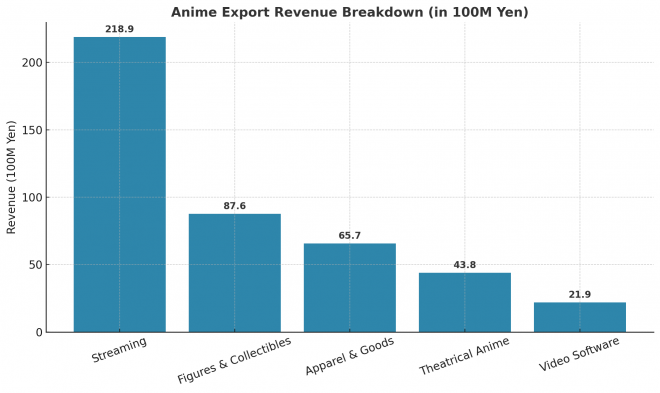
Breakdown of Anime Exports to the U.S. (Created by the Author)
In other words, excluding streaming, approximately 21.9 billion yen (approx. $148 million) in exports will be subject to the new tariffs.
Since apparel has already been taxed traditionally, the 15.3 billion yen (approx. $103 million) from the other categories will face a 15% tariff.
That amounts to 2.2 billion yen (approx. $15 million) in additional costs. Surprisingly, this impact may not be as severe as initially thought.
100% Tariffs on Foreign Films Under Consideration?

Large “Demon Slayer” Advertisement at Shinjuku Station (C) Koyoharu Gotoge / Shueisha · Aniplex · ufotable
However, tariffs are a recurring, long-term burden, and as export volumes grow, so will the amount of tax.
Additionally, reports suggest that the Trump administration is considering a 100% tariff on foreign films to protect domestic industries.
If this materializes, the 4.38 billion yen (approx. $30 million) in theatrical anime exports would take a major hit.
Furthermore, the Trump administration has frequently hinted at a potential withdrawal from the WTO.
If this happens, the WTO rule that exempts digital distribution from tariffs could be nullified.
Should these scenarios become reality, an additional 8.0 billion yen (approx. $54 million) in tariffs could be imposed, bringing the total to nearly 10.0 billion yen (approx. $68 million), raising concerns about the mid- to long-term impact on the industry.
Simply put, this means that the cost for American anime fans to enjoy Japanese anime and merchandise will increase.
On the other hand, if the anime industry as a whole can overcome these challenges, it could pave the way for healthier international expansion of the industry.
As mentioned at the beginning, anime is now one of Japan’s flagship industry and cultural brands, so we intend to keep a close eye on its future impact.

Related News
Special Feature: Looking Back at Demon Slayer by the Numbers
The first part of the three-part final arc of Demon Slayer: Infinity Castle Arc, the grand finale that has ...

Hideaki Anno Appointed as Director at Production I.G
Hideaki Anno, president of Khara and creator of Evangelion, to join Production I.G as a board director star...

Japan’s Animate to Open Its First-Ever Store in Paris This July
Japan’s largest anime retailer, Animate, is set to open its first-ever store in France. The new location, n...

Pokémon Sleep Study Links Irregular Sleep to ¥1 Trillion ($7B) Loss
On July 11, The Pokémon Company and the International Institute for Integrative Sleep Medicine (IIIS) at th...

TBS and Square Enix Announce Partnership to Develop a Brand-New Original Game IP
On May 14, TBS officially announced a strategic partnership with Square Enix to co-develop a completely new...

INTERVIEW: Is “Manga Is Hugely Popular Worldwide” Really True? Overseas Realities, Hidden Challenges, and What’s Needed to Boos...
Anime and manga are often touted as Japan’s proud, globally beloved cultural exports. However, particularly...