“Reijo” Genre Gains Rapid Popularity Overseas… Why Terms Like “Senpai” and “Isekai” Are Left Untranslated
■ “Senpai,” “Isekai,” “Reijo,” and “Manga”… Why They're Deliberately Left Untranslated
Today, “#Reijo” consistently ranks among the top tags in monthly sales on MangaPlaza.
Mr. Katsuki:"At this year's Anime Expo, we even had fans visiting our booth dressed in Reijo cosplay, which really allowed us to feel the growing excitement around the genre firsthand. The Reijo genre originally evolved from 'Narou-kei' web novels in Japan and first gained traction among male readers, but since MangaPlaza has promoted it with a focus on female audiences, over 90% of Reijo readers on our platform are women."
It's also worth noting the deliberate choice not to translate the word Reijo—which means "a noble young woman"—into English, but rather to promote it as-is in its original Japanese form.
Mr. Katsuki:“For example, Isekai (alternate world) has already become an established genre term overseas, kept in Japanese. Other words like Senpai have also spread globally through manga. In fact, there's meaning in the fact that manga itself is recognized as Manga, not simply translated as comics. Likewise, rather than narrowing its meaning through a straightforward English translation, we hope to develop Reijo into a genre that readers can interpret with all its original context included.”

Plus‑sized Misadventures in Love!© Mamakari / Cmoa Comics
One notable topic in the realm of female-oriented manga is the announcement that "Plus‑sized Misadventures in Love!" (from Cmoa Comics) is set to be adapted into an anime in both Japan and the U.S. In Japan, the title gained popularity as an original work from Comic Cmoa and was even adapted into a live-action drama. On MangaPlaza, it has also been one of the platform’s most popular titles since its launch.
Mr. Katsuki:"At this year's Anime Expo, passionate fans visited our booth and shared just how much they love the series. We also set up a display with manga panels covering an entire wall, allowing visitors to read parts of the story—and many people were completely absorbed as they stood there reading."
The story follows a female protagonist who once struggled with insecurities about her curvy body, but after losing her memory in an accident, she transforms into a remarkably positive and confident person. In North America, the series has also been highly praised for its strong body-positive message.
Mr. Katsuki:"This reaction was unexpected. In Japan, most feedback focused on how the protagonist’s strong sense of self-worth inspires happiness in herself and those around her, with fewer comments specifically highlighting her body type. While the points of emphasis differ, both Japanese and North American readers have said, ‘This is exactly the kind of story we’ve been waiting for!’ The series clearly has strong potential, and we’re optimistic that its popularity will grow even further after the anime adaptation."
■ Despite the Rise of Digital Comics, Print Manga Still Dominates in North America with a Striking “9 to 1” Ratio
The North American manga market is beginning to uncover new readers, but it still remains much smaller in scale compared to anime. So who exactly are these passionate manga fans driving the momentum in North America?
Mr. Katsuki:"They might be people with a certain level of disposable income. That’s because, even today, print manga still overwhelmingly dominates in North America by a 9-to-1 ratio—despite the fact that a single volume typically costs between $15 and $20, which is quite expensive. While digital comics are offered at more affordable prices, many readers say, ‘I read digital too, but I want to own the print version as well.’"
Given this market backdrop, MangaPlaza is now considering expanding its original titles into print as well. That said, in a North American market where anime-adapted works enjoy dominant popularity, what does it take to grow new IP and manga titles that haven’t been adapted into anime?
Mr. Katsuki:"We want to create a reversal of the current trend in the North American market—where, instead of anime leading the way, it’s the manga that becomes a hit and then gets adapted into anime, like we often see in Japan. By leveraging the broad reach of digital-first platforms, we aim to make manga the central driver of IP fandom. To achieve that, we believe it's essential to further promote the adoption of digital comics."
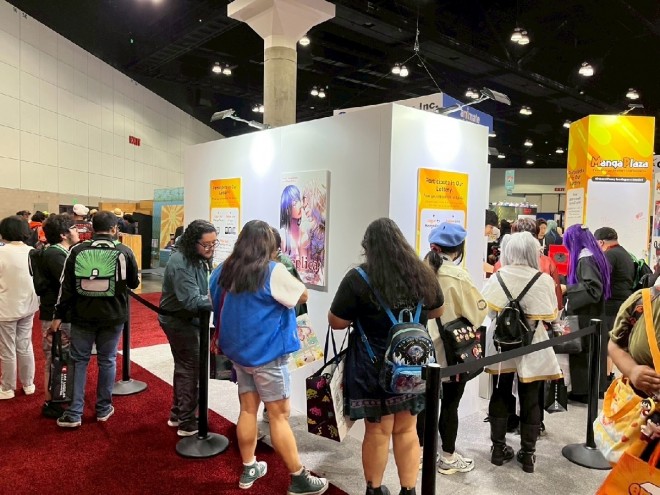
Inside the MangaPlaza Booth at Anime Expo 2025
MangaPlaza offers over 140,000 titles, making it one of the largest manga platforms in North America—yet the team humbly acknowledges that this is “still not enough.”
Mr. Katsuki:"Expanding the lineup is essential to energize the market. For a long time, Japanese publishers were cautious about selling digital comics overseas due to concerns over piracy. However, MangaPlaza has achieved 300% year-over-year growth for two consecutive years, which has helped demonstrate that legitimate digital manga can indeed sell well. The supply of titles is now growing rapidly, and alongside that, the number of users we’re able to reach is steadily expanding."
To expand the North American manga audience beyond just high-disposable-income readers and into more casual, mainstream fans, the spread of digital comics is essential. Of course, there are challenges—and one of the biggest hurdles is the speed of translation.
Mr. Katsuki:“Simultaneous releases with Japan—without any time lag—are extremely important in combating piracy. Major publishers have already begun doing this, but the effort and cost involved in translation are by no means small. That’s why I believe it’s crucial for Japan’s manga industry to approach the North American market not as competitors, but with a unified ‘All-Japan’ mindset. While we operate a digital manga store, we hope to see even more players join us in bringing Japanese manga culture to the world. The North American manga market has nothing but room to grow!”
The North American market remains a vast frontier with immense untapped potential for Japanese manga content. As platforms like MangaPlaza continue to push boundaries, there’s great hope that these digital initiatives will help pave the way for a new era in the future of Japanese manga.
(Written by Sumiko Kodama)
Source : ORICON NEWS

Related News
Latest: Japan Weekly Manga Sales Ranking As of August 4 2025 Announced by Oricon
Oricon (Japanese research organization) released its weekly manga ranking for the week of August 4 2025.

The final volume (Vol. 15) of My Dress-Up Darling manga will be released on July 25! To celebrate, Animate will hold a special ...
Animate Co., Ltd. will launch the "My Dress-Up Darling Manga Completion Fair" and a special bulk purchase c...

Final Volume of “Space Brothers” Announced: Manga to Conclude After 18-Year Serialization with Volume 46
The 45th volume of the manga Space Brothers (Uchuu Kyoudai) was released on July 23. Alongside the release,...

AiNA THE END to Perform at Manga Barcelona (Salón del Manga de Barcelona) 2025
AiNA THE END, the artist behind the anime Dandadan season 2 opening theme "On the Way," has been confirmed ...

Frieren: Beyond Journey’s End Manga Tops 30 Million Copies Worldwide and Returns on July 23
The beloved manga Frieren: Beyond Journey’s End has surpassed a worldwide total of 30 million copies in cir...