“They Reincarnated Too Many Into Isekai” KADOKAWA’s Core Publishing Business Suffers Sharp Profit Decline, Can the Publisher Move Beyond Its Overdependence on Narou Fantasy?
KADOKAWA announced its full year financial results for the fiscal year ending March 2026 on May 14, reporting a steep decline in profitability. Consolidated operating profit fell 51.3 percent year over year to 8.1 billion yen (approximately 51.3 million USD), while its core publishing business slipped into a 1 billion yen operating loss (approximately 6.3 million USD loss).
KADOKAWA logo
According to the company, one of the major causes was an excessive dependence on already proven commercial formulas, particularly Narou style fantasy and isekai reincarnation stories. KADOKAWA stated in its earnings materials that relying too heavily on “existing winning patterns” led to market saturation and reduced originality across its lineup.
The company explained that while it aggressively increased the number of editors and published titles, many projects lacked freshness and quality, resulting in fewer breakout hits and declining sales per title.
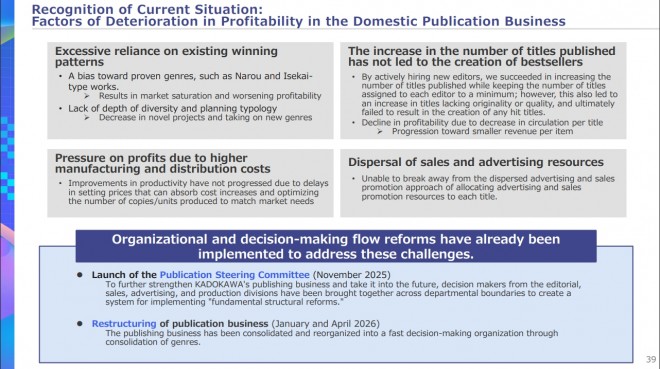
from KADOKAWA Earnings Results Report
“Reincarnated Into Another World” Became an Endless Formula
Anime fans around the world are already familiar with the phenomenon. Narou inspired stories, originally popularized through the user generated fiction platform Shosetsuka ni Naro, often revolve around protagonists gaining overpowered abilities after reincarnating into another world.
Over time, countless variations of the same setup flooded the market.
At this point, the trend has almost reached the level of “Ohgiri,” a Japanese comedy game where participants compete to give funny or absurd answers to prompts.
Even this season includes an anime about a protagonist reincarnated as a vending machine wandering through a dungeon.
KADOKAWA likely understood the risks long ago. However, these formula driven works were relatively easy to produce quickly, making them commercially convenient. As a result, the company may have struggled to shift resources toward cultivating entirely new genres and creators.
Consumers also appear to have reached a breaking point. The market became so oversaturated with similar concepts that audiences rapidly grew tired of the genre itself. With so many nearly interchangeable titles available, discovering new works became increasingly difficult.
Concerns Over Creative Quality and Originality
While many isekai works that received anime adaptations undeniably attracted large readerships, concerns about creative quality have become difficult to ignore.
Because these stories can often be generated simply by rearranging familiar elements, the environment may not have encouraged the growth of highly original creators. Instead, many works began to feel closer to hobby level experimentation rather than fully refined commercial storytelling.
The issue was not necessarily that all isekai stories were bad. Rather, the industrial scale repetition of the same narrative structure gradually weakened the genre’s impact.
Anime Business Also Falls Into the Red
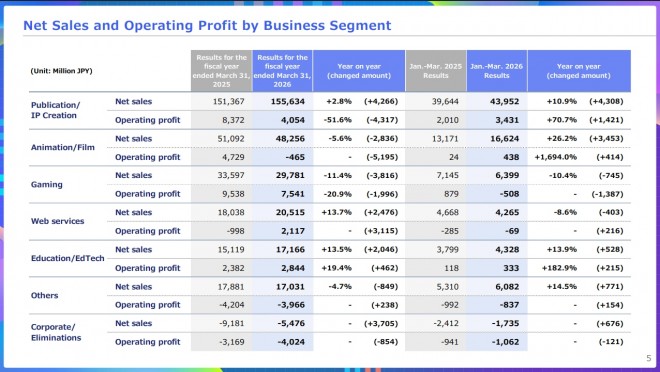
from KADOKAWA Earnings Results Report
Another major miscalculation for KADOKAWA was the deterioration of its anime business, once considered a major growth area.
The anime segment swung from a 4.7 billion yen operating profit (approximately 29.7 million USD profit) in the previous fiscal year to a 460 million yen operating loss (approximately 2.9 million USD loss). Even more alarming, the company’s operating profit forecast for the fiscal year ending March 2028 is effectively zero.
KADOKAWA cited several external pressures, including fierce competition for popular source material, rising production costs, labor shortages, and escalating competition over animation production capacity.
The company also recorded a 2.9 billion yen extraordinary loss (approximately 18.4 million USD loss) related to animation studio Doga Kobo, which it previously acquired, suggesting that its investment strategy has not produced the expected results.
In addition, KADOKAWA suffered approximately 2.4 billion yen in extraordinary losses (approximately 15.2 million USD loss) following a large scale cyberattack in 2024, further damaging overall performance.
Structural Reform and the Search for New IP
KADOKAWA has also rejected a proposal from Hong Kong based investment fund Oasis Management calling for the dismissal of President Takeshi Natsuno.
Facing mounting pressure, the company announced plans for sweeping structural reform. KADOKAWA will implement workforce reductions, including an early retirement program targeting employees aged 45 and older. It also plans to streamline its diversified business structure and strengthen cost management.
At the same time, the publisher unveiled a new six year midterm management plan running through the fiscal year ending March 2032. The first two years, covering fiscal 2027 and 2028, are positioned as a “structural reform period.”
History has shown that even great companies can enter new growth phases after periods of crisis and transformation. Many fans and industry observers will be watching closely to see whether KADOKAWA can once again create powerful new IP capable of reshaping the anime and publishing landscape.
Source : KADOKAWA IR

Related News
KADOKAWA and note Announce Strategic Capital Alliance to Build Next-Generation IP Ecosystem for Creators
KADOKAWA and note form a strategic alliance to build a next-generation IP ecosystem, supporting creators th...

KADOKAWA to Open Massive Anime Production Hub “Studio One Base” in Ikebukuro, Tokyo in Fall 2026
KADOKAWA announced plans to open a large scale anime production hub called Studio One Base in Ikebukuro, To...

Aniplex and KADOKAWA Establish ANIMEC: New Anime Film Distribution Company Launched Through Joint Investment
Aniplex and KADOKAWA have jointly established ANIMEC, a new anime film distribution company, marking a stra...

Kodansha, KADOKAWA, Shueisha, and Shogakukan Win Copyright Lawsuit Against Cloudflare for Supporting Manga Piracy Sites
Major Japanese publishers Kodansha, KADOKAWA, Shueisha, and Shogakukan have won a copyright infringement la...

KADOKAWA Updates Japanese History Manga to Reflect Modern Research and Gender Balance
KADOKAWA announced that its Manga Learning Series: Japanese History has surpassed 10 million copies in tota...
The Rising of the Shield Hero Season 5 Confirmed! New Teaser Released and KADOKAWA’s First Global Game Project Begins
The Rising of the Shield Hero Season 5 is confirmed with a teaser visual and trailer. KADOKAWA also launche...