Analysis: Why Did Japan Become the Kingdom of Characters?
That said, Japan’s character business is not guaranteed to remain secure forever.
This is because new intellectual properties (IPs) are not easily created, and even when they are, it takes time for them to grow.
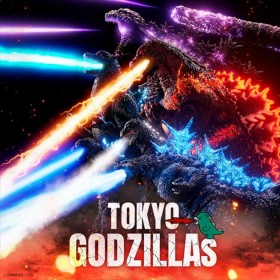
For example, Godzilla debuted in 1954, Hello Kitty in 1974, Mario in 1981, Dragon Ball in 1984, and Pokémon in 1996.
Godzilla has existed for 70 years, Hello Kitty for 50, and even Pokémon is nearly 30 years old.

Hello Kitty, which celebrated its 50th anniversary in 2024 (C) 2024 SANRIO CO., LTD.
That alone shows how much time it takes for a character to be loved and accepted.
However, the number of creators—particularly animators—is declining due to Japan’s shrinking population.
Although it is necessary to continue launching new IPs, the number of people capable of creating them is decreasing, which poses a major challenge.
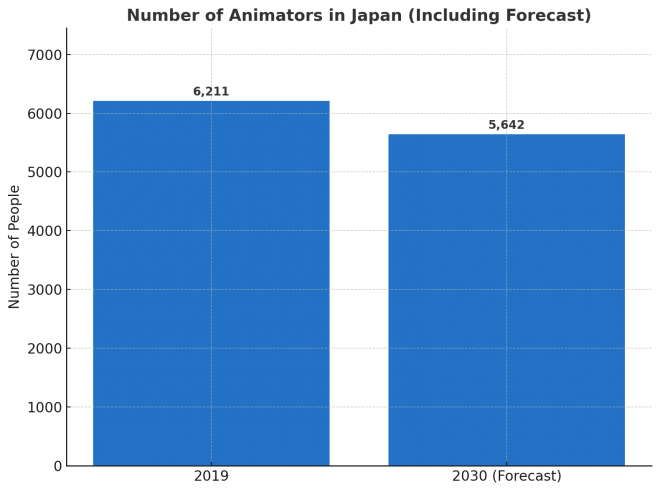
Projected Population of Japanese Animators (Based on Research by Japan Research Institute)
At the same time, it is not simply a matter of recklessly churning out new IPs.
Recently, characters like Demon Slayer: Kimetsu no Yaiba, My Hero Academia, and Chiikawa have gained popularity.
Yet Shueisha, the publisher, is not publicly listed, and Chiikawa is a manga that author Nagano started on social media.
For listed companies with substantial capital, the attempt to deliberately create IPs for profit can become problematic. If such projects fail, they risk negatively impacting performance and stock prices, which inevitably leads to short-term thinking.
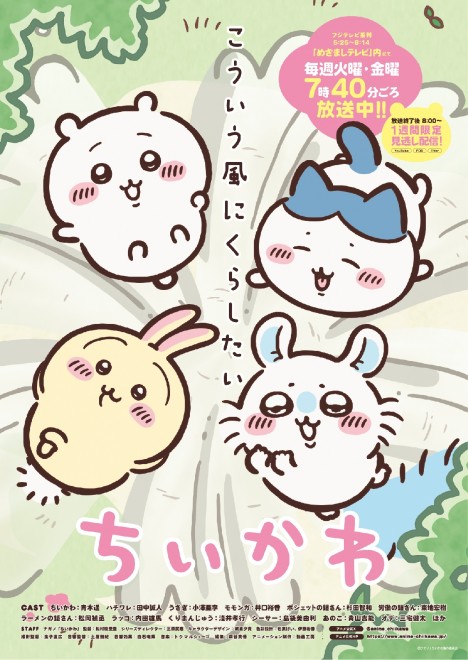
Visual of the anime Chiikawa (C) Nagano / Chiikawa Production Committee
Conclusion
To preserve Japan’s creativity into the future and enrich people’s lives with high-quality works, it is essential to both secure creators and maintain a healthy cycle of renewal for content.
Examples like Chiikawa, which began on social media and grew into a social phenomenon, show that we live in an age where anyone can become a creator. This environment aligns perfectly with the Japanese worldview of “Yaoyorozu no Kami,” the belief in Eight Million Gods that see spirit in all things.
For this reason, both publishers and fans must learn to recognize truly high-quality works, invest in them appropriately, and nurture them over the long term.
Rather than binding creators for short-term profit, society as a whole must support a sustainable cycle of creativity.
As long as that is achieved, Japan’s creativity will never be lost.
Source:
"Entertainment Contents∞2023-Last chance to change-[Reference Materials Collection]," Keidanren
“Content-Related Reference Materials,” Cabinet Office, Intellectual Property Strategy Headquarters
“Japan’s content market size in 2024 showed a slight increase from the previous year, reaching 14.9003 trillion yen.” Human Media Inc.
"Challenges on the Supply Side of Japan's Animation Industry." — JRI

Related News
Captain Pikachu Makes Surprise Appearance at ME:I Concert in Yokohama with Special Collaboration Performance [Spoilers]
Captain Pikachu joined ME:I’s Yokohama arena tour stop for a surprise performance of “Ready GO” from Pokémo...
![Captain Pikachu Makes Surprise Appearance at ME:I Concert in Yokohama with Special Collaboration Performance [Spoilers]](/upimg/thumb/5000/5799/img280/ME-I -pikachu.jpg)
Jump Magazine and Pokémon Join Forces for the First Time—Special Fold-Out Cover Features ONEPIECE, Kagurabachi, and More
Weekly Shonen Jump and the globally beloved Pokémon franchise have teamed up for the first time ever, unvei...

[INTERVIEW] My Melody & Kuromi: Director Misato on Sanrio’s New Challenge
The Netflix series My Melody & Kuromi, featuring beloved Sanrio characters My Melody and Kuromi, begins str...
![[INTERVIEW] My Melody & Kuromi: Director Misato on Sanrio’s New Challenge](/upimg/thumb/5000/5464/img280/sanrio-my-melody-kuromi-netflix-2025-01.jpg)
LE SSERAFIM Talks Bonds with My Melody & Kuromi
LE SSERAFIM appeared in a new talk video surrounded by My Melody and Kuromi merchandise, discussing group b...

SPY×FAMILY × Sanrio Collaboration Brings Exclusive Pop-Up Shops in Japan
The hit anime SPY×FAMILY is teaming up with Sanrio for an exclusive collaboration featuring adorable new vi...

JUMP SHOP Osaka Tennoji Store Reopens Permanently on Aug 1
Shueisha’s officially licensed JUMP SHOP Osaka Tennoji Store will reopen as a permanent location on August ...

Shonen Jump+ Game “Jump+ Jumble Rush” to Launch in Fall 2025
Bandai Namco Entertainment announced on July 3 that Jump+ Jumble Rush, a new smartphone game based on the S...

DIGIMON BEATBREAK Reveals New Visuals for Tomoro Tenma, Reina Sakuya, Makoto Kuonji and Partners
The upcoming anime DIGIMON BEATBREAK, the tenth television series in the Digimon franchise, has released ne...
Kaiju No. 8 Rocks Anime Expo 2025 with Godzilla Collab and Live Voice Acting
From July 3 to 6, Anime Expo 2025 took place in Los Angeles, with Kaiju No. 8 drawing a massive crowd at it...
Historic Godzilla Returns in Projection Mapping at Tokyo Metropolitan Government Building: Phase 2 Starts November 30 (Nov. 202...
On November 3, 1954, Godzilla first appeared on movie screens, captivating audiences not just in Japan but ...